Team Recreations
Several Anglo-Saxon cemeteries have been discovered by archaeologists, offering a glimpse into the burial practices of early medieval England. There were two types, inhumation and cremation, where either the body was buried with several objects, or they were burned to ash and put in a pot respectively. We are focusing on inhumation, which was common among noblemen and noblewomen. In the case of a female burial, objects that are typically found are wrist clasps, beaded adornments, cruciform, annular, and square-headed brooches, combs, girdle hangers, and ivory ring for a purse. By analyzing the presence of these objects and their relevance to Anglo-Saxon society, we can begin to understand the formation of identity and the preservation of memory. Although we do not have a lot of evidence from the time period, a great example of funerary practices comes from Beowulf.
The Geats began the pyre, howling over
Beowulf, their best brother, hanging hoard helmets
about it, shields and steel-shirts, as he’d insisted.
They placed him in the center of all this treasure,
their lost love, and built a bone-fire worthy
of men’s ends…
… His bones
blackened as his boys bellowed their grief.
Then another dirge rose, woven uninvited
by a Geatish woman, louder than the rest.
She tore her hair and screamed her horror
at the hell that was to come…
The Geats got down to it, driving the materials
of the memorial into a mound, a promontory
crowned with Beowulf’s marker…
Twelve thanes, battle-tested sons of worthy men,
took themselves to horseback and coursed
around the tomb, weeping, wringing
the old songs from their tongues, dirge-chanting,
telling the legend of Beowulf, their king.
Beowulf, trans. Maria Dahvana Headley, lines 3137-3143, 3146-3151, 3155-3157, 3168-3172. (New York: MCD X FSG Originals, 2020)
The Objects of Eriswell Grave 28
We chose to base our presentation around a recreation of Eriswell Grave 28. The grave was a great example of a high status female burial, with a high number of well-catalogued grave goods. Notably, many of our classmates had also recreated items from this grave, so we already had a collection of items readily available for a physical reconstruction of the grave.
Others of the objects displayed at the MEMEfest’22 were made in the makerspace with the talented hands of the reenactment group. Journeying there early in the afternoon after class, we worked and toiled till the sun turned its back on us. We used the materials on hand to recreate the look of its Anglo-Saxon parallel. Many of our recreations were done with modeling clay, because of its workability.
Making the Wrist Clasps
In order to make it, we used the clay in Makerspace and cut a piece of clay from the original clay bars. After that, we used an art knife to shape that piece of clay into a rectangle. And then we met the most challenging part: using small scrapers, tweezers, and awls to crave the decorative design and some holes on the surface of the plate clay.
The making of wrist clasps and the recreation of how people wore the wrist clasps largely helped us to understand how wrist clasps used to close the sleeves or the pure literal description might be so abstract that we cannot imagine the functions of clasps. We also discovered the difficulty of creating these small and tiny items.
Beaded Necklace
Although we did not have access to glass beads or fancy gems, we used plastic beads found in the Makerspace of a similar color to the necklace found in the grave. The beads were a bit smaller in size, and much shinier because of their material, but the end result was intended to provide a general visual of what the noblewoman’s necklace may have looked like.
Ivory Ring (and purse)
Creating this representation of the Eriswell 28 purse required a lot of creativity. Since the Makerspace didn’t have any flexible yet stable materials to make a larger-sized ring, we compromised with a plastic bracelet to represent the ivory ring that was the opening of the purse. Luckily, there was plenty of natural-colored fabric to simulate the wool fabric that could have been used in purses of this type (another period option for the bags of ring purses would have been leather).
Setting up the “Grave”
The items from Eriswell Grave 28 are currently on display in the museum at the West Stow Anglo-Saxon village.

As these items are displayed currently, they do not reflect the actual placement of the items in the grave, and make it difficult to imagine how they would actually have been worn. When planning how we would display our recreations of the items, we took inspiration from the arrangement of items as they have been found archaeologically in graves, as well as some recreations of Anglo-Saxon dress. We wanted to combine these ideas to give an image of how the grave would have looked like at its moment of creation.
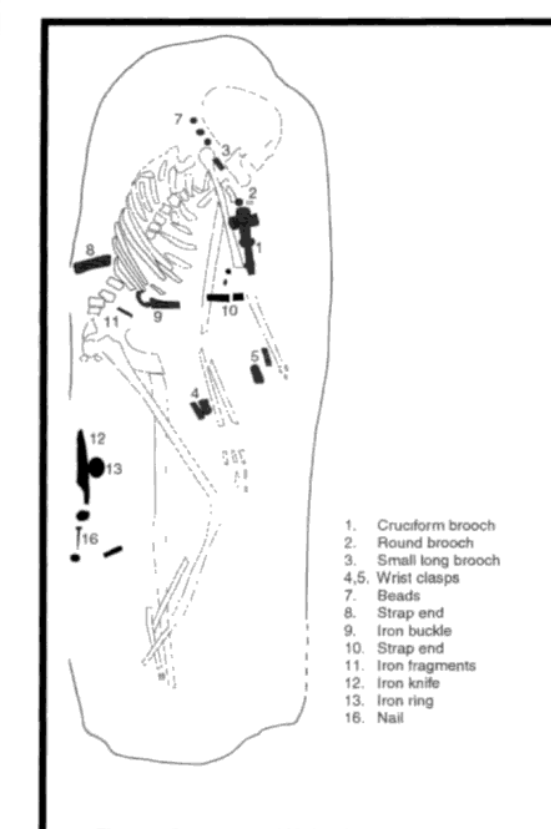
(Image from Gale Owen-Crocker, Dress in Anglo-Saxon England: Revised and enlarged edition, p. 38. Woodbridge:
The Boydell Press, 2004)
Since we didn’t have an actual person to provide scale on our display, we tried to simulate one of the garments worn by Anglo-Saxon women to help the viewer imagine the absent body. We folded a blanket to resemble the “peplos” gown, belted with a leather belt like that which was probably worn by the Eriswell woman.
We presented the objects similar to how they would have been arranged in the grave, with plaques nearby each of the objects describing their historical context, the method of historical construction, and our method of reconstruction. We thought that this display provided an intuitive way for viewers to gain insight into historical burial practices, in a way that was familiar to them to not distract from the subject of the presentation.

To read the text of each label, click the object name below.
Ivory Ring With Purse

A common item discovered in burial sites was the ivory ring, probably used as the opening of a purse hanging from the girdle. These would often be made of leather and would contain various objects that denote wealth. One common item discovered in them were coins, but often the coins seem to have been specially chosen as there is an overrepresentation of coins from foreign regions such as Byzantium, the Frankish kingdoms, and even Islamic coins.
Beaded Adornments

Bead jewelry was common in the Anglo-Saxon period. Beads were often made of glass or amber and have been found in a multitude of grave sites.
Composite Antler Comb

Antler combs were a common item in Anglo-Saxon society, however their construction required skilled craftsmen to achieve. The comb is traditionally constructed out of multiple antler “plates,” with two being used as handles and five to seven being used as the teeth plates. The teeth plates are placed between the handle plates and rivets are driven into the plates to retain the structure of the comb. Teeth are then sawed into the teeth plates, and the entire comb is filed for comfort and design.
Cruciform Brooch

The cruciform brooch is a uniquely Anglo-Saxon evolution of the small-long brooch, found particularly within the eastern regions of Anglia. Its most complex “florid” forms, such as the example shown here, date from around the mid-6th century CE. Cast from copper alloy, the complex design features bird and horse head motifs along with anthropomorphic faces. It was likely used as a central fastener to an outer garment such as a cloak, worn by a high-status woman, probably later in life.
Annular Brooch

In burials, annular brooches were usually found around the shoulder or chest area. This brooch in particular, given its lack of ornamentation, was likely just used to fasten a cloak or dress. This brooch was likely cast with copper alloy, a more valuable material than something like iron. Because of this, it could have served a secondary purpose beyond jewelry as a status symbol.
Wrist Clasps
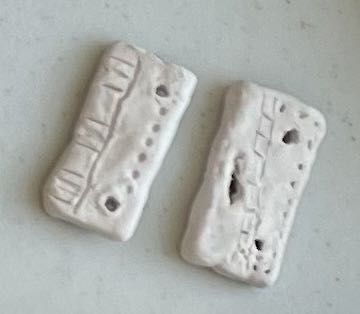
A wrist clasp is a mechanism made of a metal hook and an eye closure, used for closing the wrist opening on a tunic. Wrist clasps are considered to be an important piece of dress accessories for both Vikings and Anglo Saxons. A class of metal object frequently found in pagan Saxon graves in the Anglian areas of England as well as on the continent of Europe. They consist of flattened rectangular or triangular pieces of bronze frequently gilded or inlaid with silver and decorated with animal ornament. Their function was to fasten the cuffs of tunics.
Girdle Hangers

Girdle hangers were made from metal, typically iron or copper alloy, and hung from a woman’s girdle (a belt put around their waist). They would be symbolic of women controlling access to the home as they resembled keys. Women from higher social groups were most likely to take on a supervisory role rather than a hands-on one while lower-status women were likely to have taken on physical work pertaining to the household.
Small-Long Brooch

Generally worn in pairs, the small-long brooch was a type of bow brooch, simpler and less ornamented than the cruciform brooch. Brooches were important clothing fasteners, and much of what we conjecture about Anglo-Saxon clothing comes from the placement of brooches, and the trace textiles left on them. In this context the small-long brooches were likely fastening the shoulders of the woman’s peplos-style gown.
Photo-Op
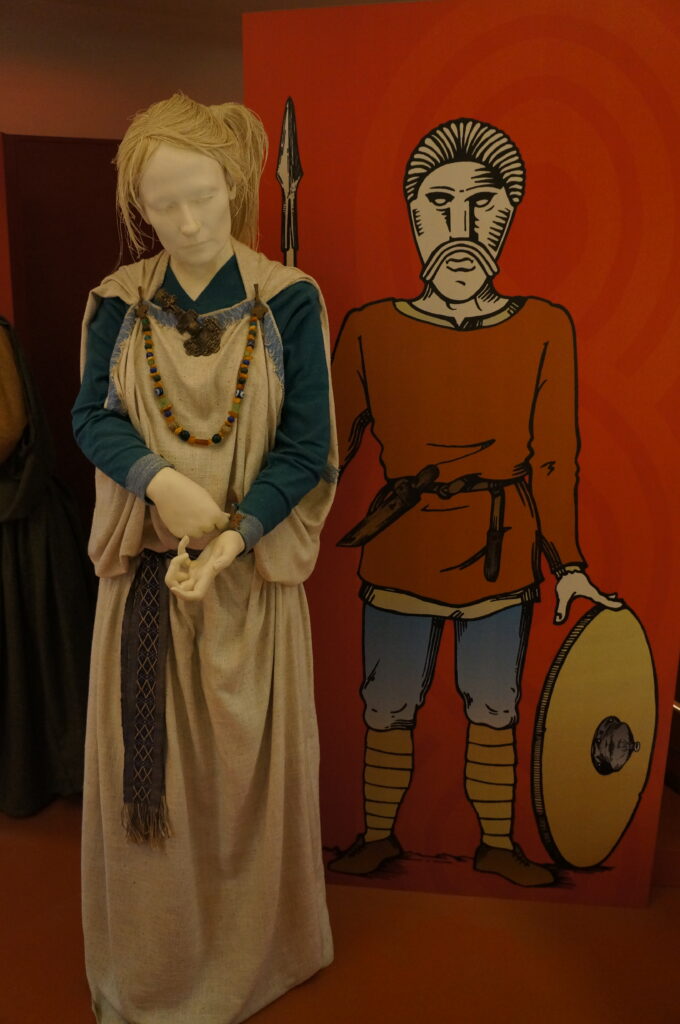
One of the other things we wanted to keep in mind was how we would grab the attention of visitors who may not have planned on learning about Anglo-Saxon England that day. To add a more eye-catching element to our display, as well as provide a more thorough, full-color visualization of the grave as it might have appeared in the Anglo-Saxon era, Sophia created a cardboard display of the Eriswell 28 woman. The display was to the scale of one of our group members and illustrated in full color using acrylic paint.
The cardboard representation provided another way for visitors to conceptualize who the noblewoman of the Eriswell 28 gravesite was in addition to the recreated object table. We encouraged guests of MEMEfest to take their photos with their faces in the cardboard display. While humorous, the photo-op activity invited people to put themselves in the shoes of a woman who lived over a millenia ago, hopefully demystifying the people who lived in early medieval England.


Reenacting the Anglo-Saxon Funeral
In addition to our static display, we wanted to include a more interactive element to our presentation. We chose to perform an Anglo-Saxon funeral for the inhumation (body burial) of a noblewoman, basing the different elements off of descriptions from Beowulf. The text outlined five main events:
- Eulogy
- Placement of grave goods
- Dirge sung by female relative
- Burial of body
- Songs of praise and feast

We first found a brave volunteer who offered to stand in as our corpse, and then we got to work. Although we could not perform an actual “burial,” we found a long couch that could serve as a make-shift grave space. Using the fabric from our display, we had our “corpse” wear the peplos dress and lay down on the cushions and a crowd gathered around. Austin Mason, our valiant professor, recited “Bede’s Death Song” in Old English, giving the eulogy. When he finished, we brought the rest of the recreated grave items, placing them in the correct locations on our “corpse.”
Up next was the funeral dirge, sung by one of the members of our group, Hannah. She chose “Caedmon’s Hymn,” based off of the YouTube version sung by Canadian musician and TV personality Peter Pringle. Watching the video on repeat, Hannah wrote down the phonetics of the Old English text and transcribed the melody, practicing it several times to memorize it. During the reenactment, Hannah sang with her heart and soul as the crowd quietly listened in somber silence. After the last note, we waited a moment, and then proceeded to “bury” the body (mimed throwing dirt into the grave). That completed our reenactment, with the crowd dispersing to feast on the delicious bread baked by the Food Team.


While we did not have a large number of visitors to our display, those who did stop by seemed to engage with the information we had to share with them. The cardboard cutout seemed to do the job of intriguing people who walked by, even if they didn’t all want to take a picture with it. Likewise, the physical objects on the table were much more engaging than two-dimensional images would have been, and also prompted questions about the making process that allowed us to talk a bit more about what we learned from reconstruction, beyond the summaries on the labels. As our static display was put in motion, it was the funeral re-enactment that drew the most onlookers, emphasizing the attraction of more embodied ways of learning about the past. Although we were far from historically accurate, at the very least, this experience prompted both us and our visitors to imagine Anglo-Saxon life in a much more vivid way.
Links For Further Reading
“An Anglo-Saxon Pagan Funeral” from Wednesbury Shire
Learn about another Anglo Saxon burial: Sutton Hoo
Another burial tradition we didn’t reenact: “Anglo-Saxon Bed Burials” from Bones Don’t Lie
